
Hive3
I designed Hive3, a Web3 education platform that takes newcomers from no blockchain knowledge to confident use.
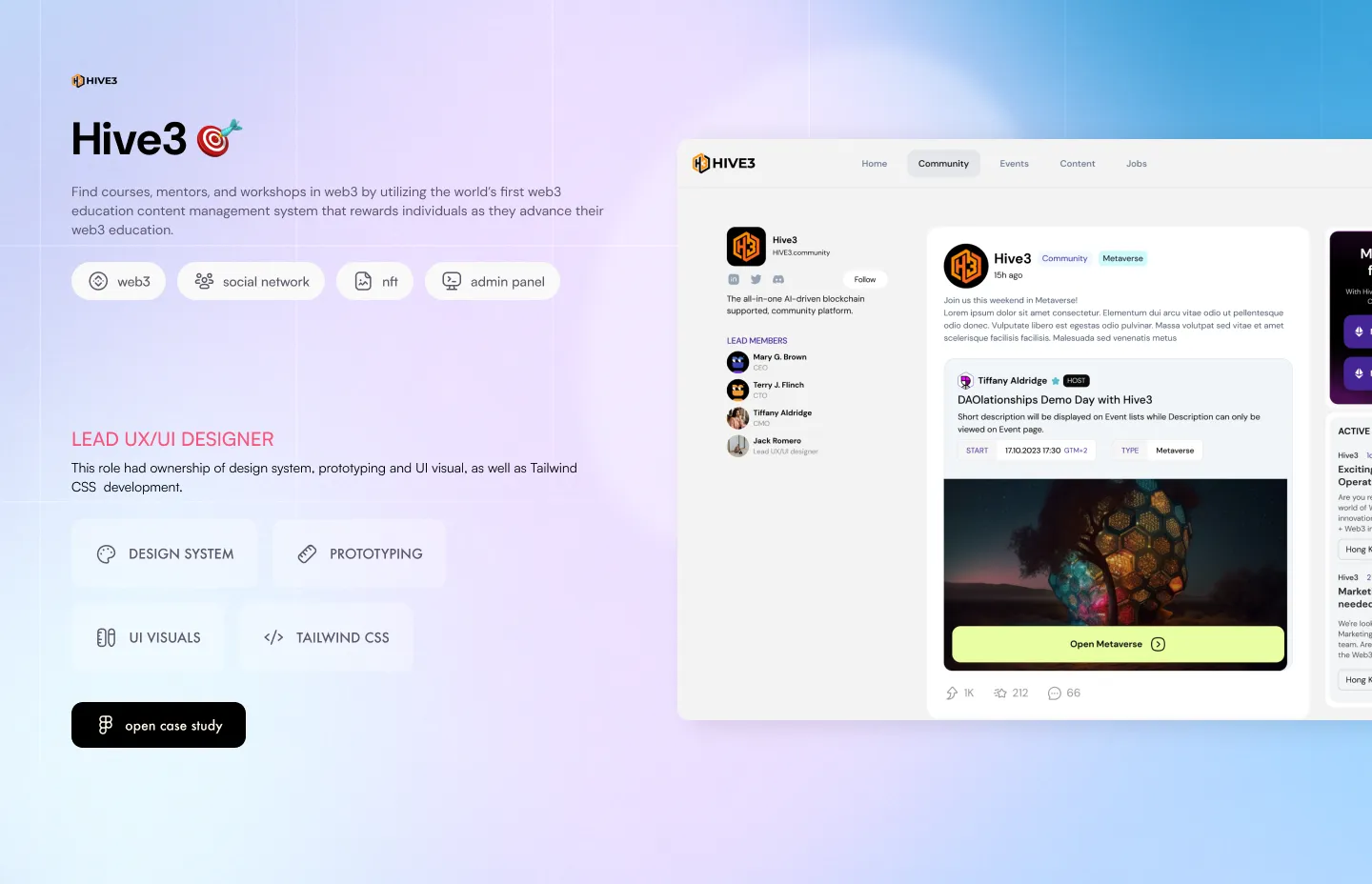
Overview
Hive3 is a Web3 education platform for people who don’t yet speak the language. Its job is to take someone from no blockchain knowledge to confident use, without losing them to jargon or a complex interface on the way.
The challenge
Web3 education has a drop-off problem. The concepts are hard, and most platforms either simplify them until they are useless or load so much technical depth up front that learners leave before they start.
The real challenge was pacing, not content. How do you teach wallets, keys, gas, consensus and tokenomics in an order that builds understanding instead of anxiety? And how does the interface tell the learner “you can do this” at every step?
Process
I started with research. I mapped learning journeys for three kinds of user: curious beginners with no blockchain background, developers moving over to Web3, and existing users who had never learned the fundamentals.
Each group had a different entry point, pace and vocabulary. The information architecture had to serve all three without splitting into separate products.
From there, progressive disclosure became the organising principle. I used it as a way to plan the curriculum, not only as a UI pattern.
Key decisions
Show complexity, don’t describe it. Each module carries a visual marker of its depth. Before they click, learners know whether they are opening a three-minute primer or a technical deep dive.
The interface grows with the learner. Early modules have a stripped-back UI. As learners progress, the platform adds more navigation and tools, in step with the content.
No jargon without support. Every technical term in a lesson has a tooltip or a linked explainer. The glossary is part of the lesson, not a separate section.
Outcome
After launch, course completion rates were well above those of comparable platforms. The design proved its point: if the interface earns trust at every step, learners stay.