Zevo
Designing the world's first peer-to-peer EV sharing platform — where electric vehicle owners earn passive income by sharing contactlessly.
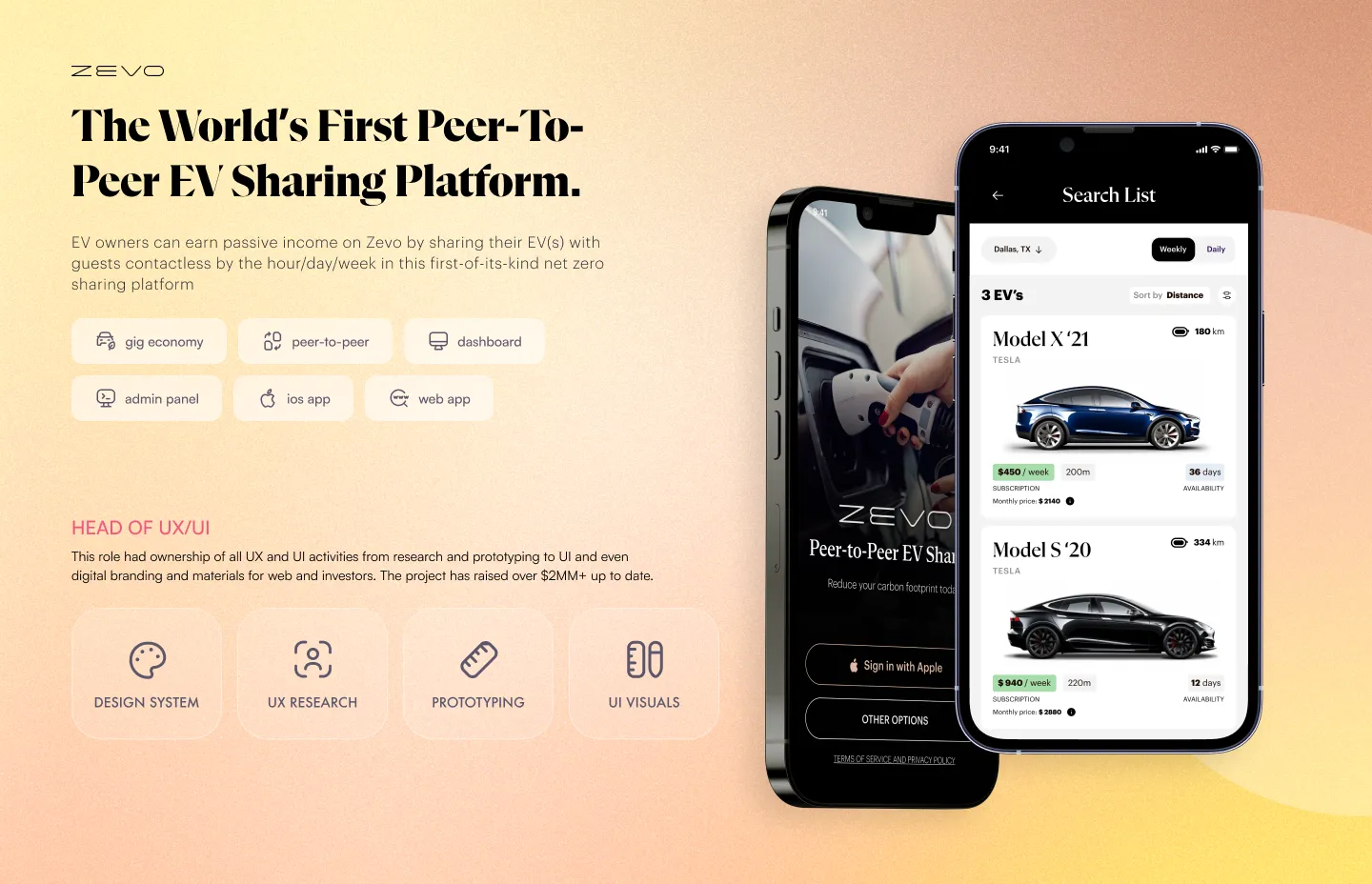
Overview
Zevo is the world’s first peer-to-peer EV sharing platform. EV owners list their vehicles and earn passive income while they sit idle. Guests book and unlock them contactlessly — by the hour, day, or week. No keys. No handoffs. No middlemen.
The startup raised a pre-seed round of $2M+. I led UX/UI design end-to-end at Digihey, Zevo’s Croatian development partner, owning every major design decision from research through prototype.
The Challenge
P2P vehicle sharing is a trust problem at its core — and it’s bilateral. Owners need confidence their vehicle is in safe hands, insured, and tracked. Guests need to know the booking is genuine, the car is where it says it is, and that unlocking it won’t require a phone call.
Contactless handoff sounds simple. In practice, it’s the highest-stakes moment in the entire user journey. Get it wrong and both sides lose faith in the platform on their first trip.
My Role
As lead UX/UI designer at Digihey, I was responsible for the full design scope across the owner and guest apps:
- UX research across both user sides
- UX flows, wireframes, and information architecture
- Full UI design for iOS and Android
- Interactive prototyping for testing and investor presentations
Design Approach
The platform has two distinct products sharing a single system: the owner experience and the guest experience. Each was designed separately, then stress-tested for the moments they intersect.
The guest booking flow mirrors the best of ride-hailing — location, availability, and price resolved in three taps. Vehicle detail pages lead with the information that builds confidence: charge level, host rating, exact pickup location, and photos from multiple angles.
The contactless unlock sequence was the critical design problem. The solution: a linear, step-by-step interface that eliminates ambiguity at each stage. Progress is visible. If something goes wrong, the next step is clear. The flow was tested extensively against real anxiety points — what if the car isn’t there, what if the app loses connection, what if the charge is lower than listed.
Owner dashboards lead with earnings. Vehicle status, booking calendar, and payout history are immediately readable. The experience makes passive income feel tangible, not theoretical.
Outcome
Zevo launched a new category in sustainable mobility — turning idle EVs into earning assets and giving guests affordable, zero-emission transport on demand. The design made both sides of that equation feel effortless.